

FNSKU Labeling in China: 2026 Amazon FBA Rules and Error Prevention
FNSKU labeling in China should start with the seller's current Amazon barcode eligibility, not a warehouse assumption. For inventory shipped on or after 31 March 2026, Amazon ended commingling and changed barcode eligibility: qualifying Brand Registry brand representatives may use eligible manufacturer-barcoded inventory, while resellers and products without an eligible manufacturer barcode generally need Amazon barcode labels. Sellers must confirm the live rule for each marketplace, account and SKU before instructing a prep center.
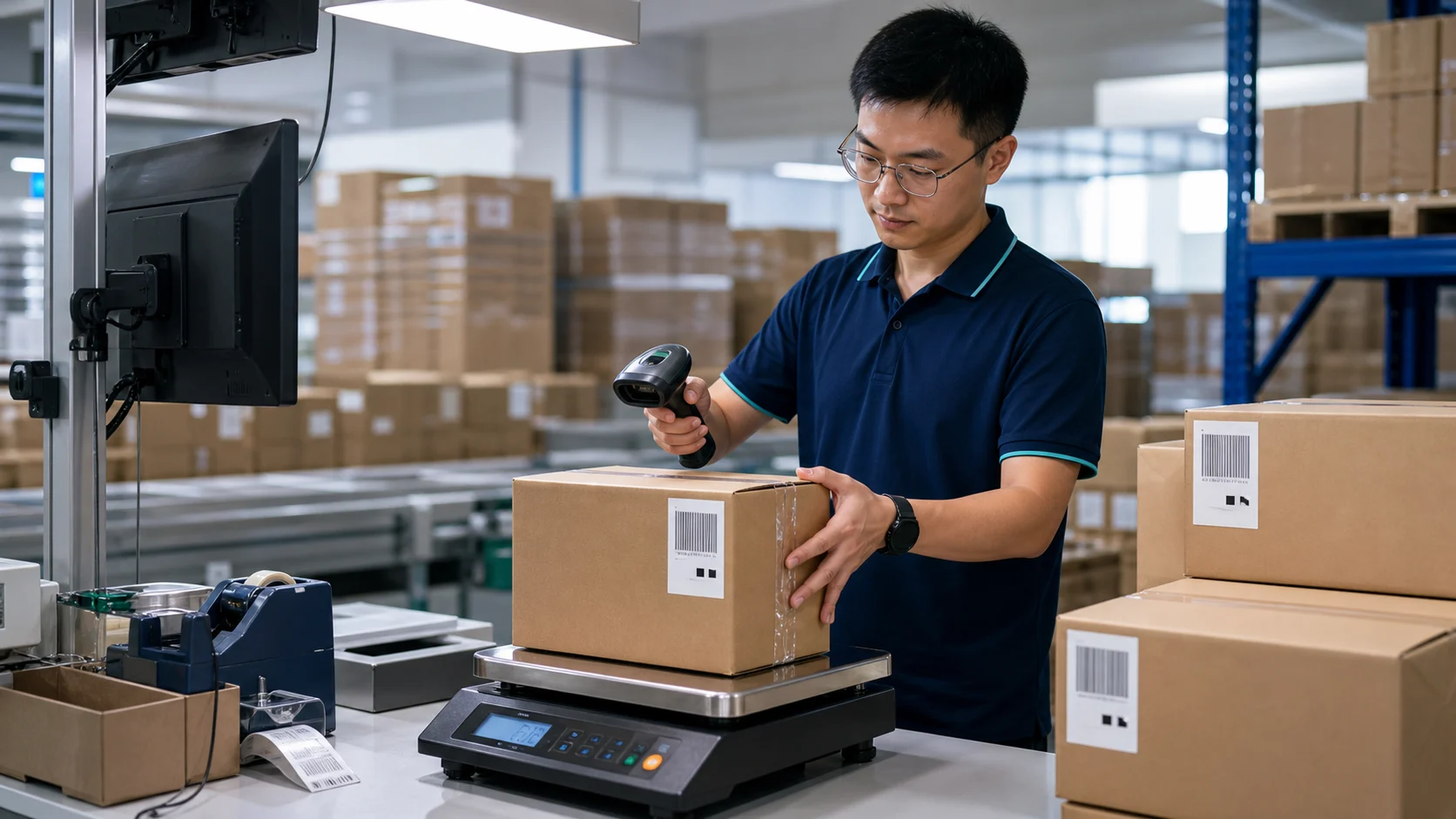
Article summary: FNSKU labeling in China should start with the seller's current Amazon barcode eligibility, not a warehouse assumption. For inventory shipped on or after 31 March 2026, Amazon ended commingling and changed barcode eligibility: qualifying Brand Registry brand representatives may use eligible manufacturer-barcoded inventory, while resellers and products without an eligible manufacturer barcode generally need Amazon barcode labels. Sellers must confirm the live rule for each marketplace, account and SKU before instructing a prep center.
1. What Changed in Amazon FBA Barcode Policy in 2026
Amazon announced that commingling would end effective 31 March 2026 and updated the eligibility criteria for manufacturer barcodes. Amazon's official announcement states that:
- Brand owners with the Brand Representative selling role in Amazon Brand Registry may not need Amazon barcode stickers for eligible products that already have manufacturer barcodes.
- Resellers are required to use Amazon barcode stickers, even when the product has a manufacturer barcode.
- Products without a manufacturer barcode require Amazon barcode stickers.
Amazon's official global-selling notice also states that its FBA prep and product-labeling services stopped for newly created shipments from 1 January 2026, making seller- or provider-applied preparation more important.
These summaries do not replace Seller Central. Barcode preference and eligibility can depend on marketplace, listing, product, condition, program and account role. Before every batch, the seller should create or review the live inbound workflow and provide the exact label files and instructions generated for that shipment.
People searching for Amazon FNSKU labeling China have informational and transactional intent. They need both the current rule and a warehouse process that prevents labels from being applied to the wrong SKU.
2. Decide Which Barcode the Unit Must Use
2.1 Separate Manufacturer, Amazon and Shipment Labels
| Label type | Operational purpose | Who must approve the source file |
|---|---|---|
| Manufacturer barcode such as UPC/EAN | Product identification across the commercial supply chain | Brand owner/listing owner |
| Amazon barcode such as FNSKU | Amazon-specific inventory identification under the seller's listing | Seller account |
| FBA box ID/shipment label | Identifies a carton in a specific inbound shipment | Seller account/shipment workflow |
| Carrier label | Routes the transport package | Approved carrier/forwarder |
These labels are not interchangeable. A unit label identifies the sellable unit; a box label identifies a shipping carton. The prep center should not generate substitute labels from a spreadsheet when the seller's platform file is available.
2.2 Use a SKU-Level Instruction
For each SKU, record:
- Seller SKU
- ASIN
- FNSKU, if required
- Product title and variation
- Condition
- Unit quantity
- Which existing barcode must remain visible
- Which existing barcode must be covered
- Final packaging surface that must be scanned
- Shipment-plan/box-label reference
The label file, instruction and physical product must be matched by at least two stable identifiers. Product photos are useful but should not be the only match key.
2.3 Confirm the Final Scannable Surface
Apply the required unit barcode to the outermost surface that Amazon will scan as the sellable unit. If bubble wrap, a poly bag or another overpack is required, the final barcode normally needs to remain visible and scannable on the outside of that preparation.
Avoid seams, folds, corners, curves and reflective or textured areas. General GS1 barcode guidance also emphasizes that barcode type, size, placement and print quality must fit the intended scanning environment.
Amazon's own barcode guidance should control Amazon-specific decisions. GS1 guidance supports print and placement discipline but does not determine FBA eligibility.
3. The FNSKU Labeling Workflow in China
3.1 Receive and Quarantine the Inventory
Record supplier, purchase order, cartons, SKU, stated quantity and visible damage. Keep unlabeled, labeled and completed units separated. Do not combine similar-looking variations before verifying their identifiers.
For products received from several suppliers, use one warehouse receiving reference per delivery. If the supplier applied a barcode, scan and record it before covering anything.
3.2 Validate the Seller's Label Pack
The seller should provide:
- Final SKU list and quantities
- Platform-generated unit label files where required
- Product-to-label mapping
- Current inbound shipment/box-label files
- Packaging and prep instructions
- Marketplace and destination fulfillment center or routing instructions
- Confirmation of manufacturer-barcode eligibility where no FNSKU sticker is requested
The warehouse should check file legibility, page scale and quantity before printing. It should not edit the encoded value, resize outside approved parameters or recreate labels manually.
3.3 Approve a First Labeled Unit
Prepare one representative unit per SKU or packaging type. Photograph:
- The product and variation identifier
- The required barcode label
- Placement relative to seams, edges and curves
- Covered obsolete/competing barcode, when instructed
- Final prepared outer surface
- A successful scan result
Obtain written approval before the run when the instruction is new or ambiguous.
3.4 Control Label Printing and Application
Use line clearance between SKUs. Remove the previous label roll, file, product and instruction from the workstation. Print only the approved quantity plus a controlled allowance for damaged labels.
Recommended controls:
- Scan the first label against the SKU master
- Separate products by SKU and variation
- Apply one label at a time
- Reconcile printed, used, damaged and unused labels
- Perform periodic scan checks during the run
- Inspect placement and adhesion
- Quarantine mismatches for review
For high SKU counts or similar-looking variations, barcode-assisted verification is safer than visual matching alone.
3.5 Pack Cartons and Apply Shipment Labels
After unit preparation, follow the approved carton quantity and packing instruction. Record final carton count, dimensions and gross weight. Generate or use the exact box labels assigned by the seller's current shipment workflow.
Keep unit labels, box labels and carrier labels in separate controlled folders or queues. Never duplicate one box ID label across cartons unless the platform instruction explicitly permits it.
3.6 Release With Evidence
The completion pack should include:
- Quantity received, prepared, held and rejected by SKU
- Label-file version and date received
- Representative first-piece photos
- Scan-check evidence
- Label reconciliation
- Final carton packing list
- Carton dimensions and weights
- Shipment/box-label reference
- Exceptions and buyer approvals
4. Common FNSKU Labeling Errors and Prevention
| Error | Likely cause | Preventive control |
|---|---|---|
| Correct label on wrong variation | Visual-only SKU matching | Scan product and label against the SKU master |
| Barcode cannot scan | Poor print, scale, contrast or surface | First-piece scan and periodic scan checks |
| Old barcode remains visible | Incomplete instruction | SKU-level “cover/keep visible” field |
| Label applied under overpack | Process sequence unclear | Define the final scannable surface |
| Label crosses seam or curve | No placement reference | Approved photo and placement check |
| Wrong shipment label on carton | Unit/box files mixed | Separate file queues and carton reconciliation |
| Rule assumed from previous shipment | Platform policy or SKU eligibility changed | Verify live Seller Central workflow for every batch |
4.1 Cost Drivers
Labeling quotations should separate:
- Receiving and SKU sorting
- Label printing material
- Per-unit application
- Barcode covering/removal
- Extra packaging or overpack
- Scan verification and reporting
- Carton packing and box-label application
- Storage, rework and exception handling
“Free labeling” should state the eligible label material, unit limit, SKU complexity and included verification. The cost of fixing a SKU mix-up can exceed the application price, so the control method matters.
5. Frequently Asked Questions
Q1: Does every FBA unit need an FNSKU label in 2026?
A: Not necessarily. Amazon's 31 March 2026 changes allow some eligible Brand Registry brand representatives to use manufacturer barcodes, while resellers and products without eligible manufacturer barcodes generally require Amazon barcode stickers. Confirm each live SKU in Seller Central.
Q2: Can a China prep center create FNSKU labels for the seller?
A: The seller should provide the platform-generated label file and SKU mapping. A prep center can print and apply approved labels, but it should not choose barcode eligibility or invent identifier data.
Q3: Should the FNSKU cover the UPC?
A: Follow the current Amazon instruction for that SKU. When the Amazon barcode is the required scannable identifier, competing barcodes may need to be covered. Record the decision in the SKU-level instruction.
Q4: What evidence should the labeling provider return?
A: Request received/completed quantities, first-piece photos, scan checks, label reconciliation, carton packing data, box-label references and a list of exceptions.
6. Conclusion and Oushine Next Step
The safest FNSKU labeling process begins with the seller's current platform instruction and ends with SKU-level evidence. A warehouse can execute and verify the physical work; the seller must control listing data, barcode eligibility and shipment creation.
Send Oushine the final SKU list, quantities, Amazon label files, product photos, preparation instruction, destination marketplace and shipment deadline. Oushine can provide a written scope for receiving, agreed inspection, repackaging, barcode application, scan checks, carton preparation and transport coordination.
Sources and Methodology
- Amazon Global Selling: 31 March 2026 FBA labeling policy change — official Amazon announcement
- Amazon Seller Forums: Commingling ends 31 March 2026 — Amazon news announcement and policy summary
- GS1: 10 Steps to Barcode Your Product — general barcode scanning and placement guidance
Editorial note: Amazon policies vary by marketplace, program, product and account and can change after this review. Seller Central instructions for the live shipment control. Last reviewed: 5 August 2026.